
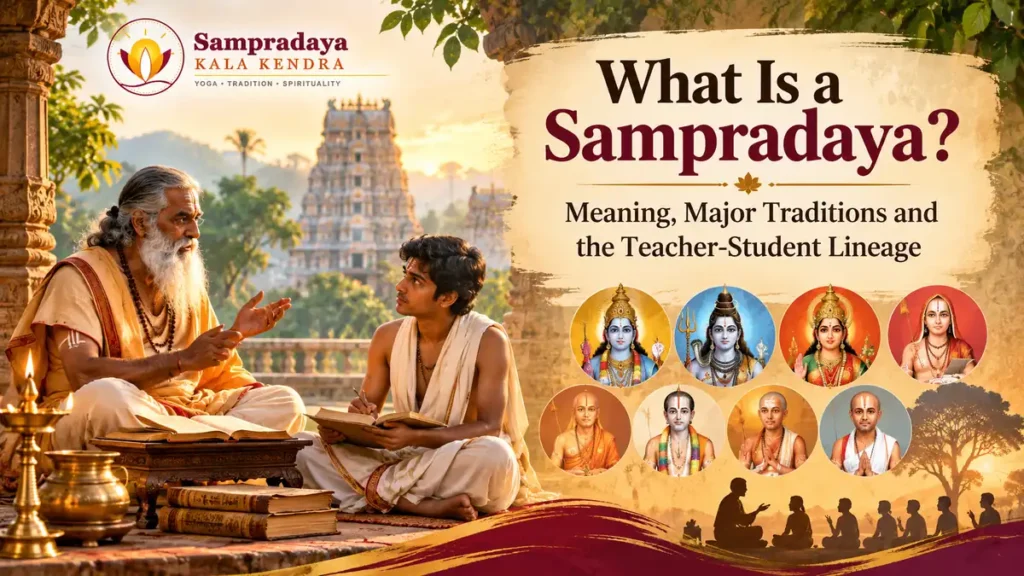
What is sampradaya? A sampradaya is an established tradition through which religious teachings, philosophical ideas, interpretations, and practices are transmitted across generations. In Hinduism, the term often describes a spiritual or philosophical tradition associated with particular teachings, teachers, forms of worship, and methods of practice.
A sampradaya is more than a collection of beliefs. It can connect sacred literature with its interpretation, philosophical understanding with daily practice, and individual learning with a wider spiritual community. Different sampradayas have developed distinctive approaches to understanding the divine, the individual soul, the world, and spiritual liberation.
Understanding sampradaya helps us appreciate the diversity of Hindu traditions and the importance of preserving knowledge while allowing thoughtful interpretation and continued learning.
What Is Sampradaya?
A sampradaya is an established religious, philosophical, or spiritual tradition that transmits teachings and practices from one generation to another. It may be associated with a recognised teacher, a philosophical school, a body of sacred literature, a particular devotional practice, or a lineage of spiritual instruction.
In Hinduism, sampradayas help explain why different communities may interpret sacred texts differently, worship different forms of the divine, or follow distinct paths of spiritual practice.
For example, a Vaishnava tradition may centre on devotion to Vishnu and his manifestations, while a Shaiva tradition may place Shiva at the centre of its worship and philosophical understanding. Both belong to the wider Hindu religious landscape, but their teachings, rituals, and historical lineages can differ.
A sampradaya may include several teacher-student lineages, institutions, regional communities, and sub-traditions. Its identity is therefore not necessarily limited to one individual teacher or one place.
Sampradaya Definition in Simple Words
A sampradaya is a tradition of teachings, beliefs, interpretations, and practices passed down through generations. In Hinduism, it often connects spiritual knowledge with teachers, students, sacred texts, worship, and an established philosophical or devotional heritage.
This definition captures the central idea, although the exact meaning depends on the historical, religious, or cultural context in which the word is used.
Sampradaya Meaning in Sanskrit
The Sanskrit word is written as सम्प्रदाय and transliterated as sampradāya.
Sanskrit-English dictionaries record meanings that include traditional doctrine, established teaching, customary practice, and a system of religious instruction. These meanings help explain why the word is used for traditions that preserve and transmit knowledge.
The term is associated linguistically with the idea of giving or transmitting. However, it is best to rely on established Sanskrit dictionaries rather than assign a single simplified word-by-word interpretation to every religious use of the term.
In a general cultural context, sampradaya can refer to an established custom or inherited tradition. In Hindu religious and philosophical contexts, it often has a more specific meaning: a recognised body of teachings and practices maintained through transmission and interpretation.
The word therefore describes not only something inherited from the past but also a tradition that continues to be studied, practised, and understood in the present.
What Is a Sampradaya in Hinduism?
Hinduism contains many philosophical schools, devotional movements, ritual traditions, and regional forms of religious practice. A sampradaya provides one way of understanding how particular teachings and practices are organised and transmitted within this diversity.
Several elements commonly contribute to the identity of a sampradaya.
1. Philosophical teachings: A tradition may explain the relationship between the individual self, the divine, and the world through a particular philosophical framework.
2. Sacred texts and interpretation: Traditions may study the Vedas, Upanishads, Bhagavad Gita, Puranas, Agamas, or other important texts. They may differ in how they interpret particular passages.
3. Worship and spiritual practice: Prayer, devotional singing, meditation, ritual observances, recitation, and temple worship may form important parts of a tradition.
4. Teachers and students: Spiritual teachers explain teachings, guide practice, and help students understand the tradition’s intellectual and practical dimensions.
5. Community and institutions: Temples, monasteries, learning centres, religious organisations, and local communities may support the continuation of a sampradaya.
Not every sampradaya has the same organisational structure. Some place considerable emphasis on formal initiation and a recognised teacher lineage. Others are maintained through texts, family practices, community institutions, or multiple forms of instruction.
It is important to remember that Hinduism is not a single uniform system. The term sampradaya helps describe this diversity without assuming that all Hindus share the same beliefs or practices.
What Is Guru-Shishya Parampara?
The guru-shishya parampara is the teacher-student tradition found in many Indian knowledge systems.
The Sanskrit word guru commonly refers to a teacher or spiritual guide, while shishya means a student or disciple. Parampara refers to continuity or succession, particularly the transmission of knowledge from one teacher to another and across generations.
In this relationship, learning may involve more than reading a text. A student can study a teacher’s explanations, observe demonstrations, practise particular techniques, ask questions, memorise material, and gradually develop a deeper understanding.
The precise relationship varies by tradition. In some spiritual settings, initiation and personal guidance are important. In classical music, dance, yoga, and other disciplines, sustained instruction and practical training may be central.
For example, a student learning a traditional musical form may learn compositions, pronunciation, rhythm, interpretation, and performance conventions from a teacher. The student receives established knowledge but also develops the ability to understand and perform it independently.
Similarly, in a philosophical tradition, a student may study foundational texts alongside commentaries written by earlier teachers. The teacher helps explain how these texts are understood within the tradition.
Many sampradayas are maintained through one or more such lineages. However, the terms should not be treated as identical: a sampradaya can encompass a broader tradition, while a parampara often emphasises a particular line of transmission.
Difference Between Sampradaya and Parampara
Sampradaya and parampara are closely related terms, and their meanings overlap in actual usage.
| Aspect | Sampradaya | Parampara |
|---|---|---|
| General meaning | An established tradition of teachings and practices | A succession or continuity through which knowledge is transmitted |
| Main emphasis | Shared philosophy, interpretation, worship, and tradition | Transmission from teacher to student or generation to generation |
| Common context | Religious, philosophical, and spiritual traditions | Teacher lineages, inherited practices, and continuity |
| Relationship | May contain multiple lineages | May help maintain a sampradaya |
| Example | Sri Vaishnava tradition | A particular Sri Vaishnava teacher lineage |
The distinction is useful for understanding these concepts, but it is not an absolute rule governing every historical or contemporary use of the words.
Major Sampradayas and Traditions in Hinduism
There is no single universally accepted count of all Hindu sampradayas. The number depends on whether a classification refers to broad devotional traditions, philosophical schools, specific teacher lineages, or smaller religious communities.
Vaishnavism, Shaivism, Shaktism, and the Smarta tradition are frequently used as broad categories for understanding important strands of Hindu religious life. Within these broader categories are numerous traditions with distinctive histories and teachings.
1. Sri Vaishnava Tradition
The Sri Vaishnava tradition centres on devotion to Vishnu and Lakshmi and has a major place in the history of Hindu devotional thought.
Ramanuja, an influential philosopher and teacher, is closely associated with the development of its philosophical tradition. His interpretation of Vedanta is known as Vishishtadvaita, commonly translated as qualified non-dualism.
The Alvars, Tamil poet-saints whose devotional hymns express profound devotion to Vishnu, are also important to Sri Vaishnava religious heritage. Their hymns became central to the tradition’s devotional and literary life.
Sri Vaishnavism illustrates how philosophical reasoning, sacred literature, devotional expression, temple traditions, and teacher lineages can work together within a sampradaya.
2. Madhva Sampradaya
The Madhva Sampradaya is associated with Madhvacharya, a major Vedanta philosopher who taught Dvaita, or dualism.
Dvaita Vedanta maintains a real distinction between God and individual souls, rather than treating their relationship as one of ultimate identity. Madhva’s teachings give a central place to Vishnu as the supreme reality.
The tradition combines philosophical study with devotion and religious practice. Its historical contribution includes the development of a distinctive interpretation of Vedanta and the establishment of a continuing scholarly and devotional lineage.
3. Gaudiya Vaishnavism
Gaudiya Vaishnavism is a Vaishnava devotional tradition associated with Chaitanya Mahaprabhu and the worship of Krishna.
A central feature of the tradition is bhakti, or loving devotion to the divine. Congregational chanting of divine names, devotional singing, scriptural study, and the cultivation of devotion are important practices in many Gaudiya communities.
The tradition has a substantial literary and theological heritage, including works by teachers who explained its understanding of Krishna, devotion, and the relationship between the individual soul and the divine.
Gaudiya Vaishnavism is one tradition within the wider Vaishnava landscape; its specific teachings and practices should not be assumed to represent every Vaishnava community.
4. Vallabha Sampradaya
The Vallabha Sampradaya is associated with Vallabhacharya and the philosophical teaching known as Shuddhadvaita, or pure non-dualism.
Devotion to Krishna, particularly in forms associated with his divine play and personal relationship with devotees, is central to the tradition. The Pushtimarg tradition is closely connected with Vallabhacharya’s teachings.
Worship, devotional service, and practices of offering and caring for the deity are important in many communities associated with this tradition.
Its history demonstrates how a philosophical interpretation of Vedanta can be expressed through distinctive forms of devotional life.
5. Nimbarka Sampradaya
The Nimbarka Sampradaya is associated with Nimbarkacharya and the philosophical position commonly known as Dvaitadvaita, or duality and non-duality.
The tradition is particularly associated with devotion to Radha and Krishna. Its philosophical framework addresses the relationship between the individual soul, the world, and the divine.
As with other Vaishnava traditions, the Nimbarka lineage combines theological interpretation with devotional practice. Its distinct identity lies in its particular philosophical teachings and its historical forms of worship and instruction.
6. Shaiva Traditions
Shaivism refers broadly to Hindu traditions in which Shiva holds a central place as the supreme deity or a primary focus of worship.
It includes diverse philosophical and devotional traditions rather than one single lineage. Shaiva Siddhanta, Kashmir Shaivism, and historical Pashupata traditions are examples of distinct Shaiva developments.
These traditions differ in their philosophical explanations, ritual systems, texts, and approaches to liberation. Some place particular emphasis on devotional worship and religious observance; others are known for sophisticated philosophical accounts of consciousness, reality, and spiritual freedom.
The diversity of Shaivism demonstrates why broad religious categories should not be confused with individual sampradayas or philosophical schools.
7. Shakta Traditions
Shaktism centres on Devi, the Goddess or Divine Mother, understood in many Shakta traditions as the supreme divine reality.
Shakta traditions include diverse forms of goddess worship, ritual practice, sacred literature, and philosophical interpretation. Their religious life may centre on particular manifestations of the Goddess, regional traditions, or specific forms of worship.
Some Shakta schools emphasise the Goddess as the ultimate reality in her own right. Others explain her relationship with Shiva through different theological and philosophical frameworks.
Shaktism is therefore not a single uniform system. Its many traditions reflect the breadth of goddess-centred religious practice within Hinduism.
8. Smarta Tradition
The Smarta tradition is associated in many historical contexts with Advaita Vedanta and the worship of multiple Hindu deities.
A practice commonly associated with Smarta worship is Panchayatana Puja, which involves worship of five deities: Shiva, Vishnu, Devi, Surya, and Ganesha. Particular forms of practice vary by community and family.
Advaita Vedanta, strongly associated with Adi Shankaracharya, teaches non-duality: the ultimate reality is understood as Brahman, and liberation involves realising the deepest truth of the self and Brahman.
Although the Smarta tradition and Advaita Vedanta are closely connected historically, it would be inaccurate to assume that every Smarta practitioner follows an identical philosophical outlook.
Why Do Hindu Sampradayas Differ?
Hindu sampradayas have developed different interpretations of sacred texts, understandings of the divine, forms of worship, and approaches to spiritual liberation.
Some place the greatest emphasis on devotion to a personal deity. Others focus on philosophical inquiry, ritual practice, meditation, or combinations of these approaches.
These differences are part of the historical complexity of Hinduism. A respectful understanding of sampradaya recognises both the distinctive identity of individual traditions and their place within a wider cultural and religious heritage.
How Does a Sampradaya Preserve Knowledge?
A sampradaya continues through a combination of teaching, practice, interpretation, and community participation. No single method is sufficient to explain every tradition.
Oral instruction: Teachers may transmit prayers, chants, recitations, philosophical explanations, or ritual procedures through spoken instruction.
Scriptures and commentaries: Sacred texts and the writings of earlier teachers help preserve foundational teachings. Commentaries explain how a tradition interprets those texts.
Teacher-student learning: Students receive guidance, practise established methods, and learn how to apply their knowledge appropriately.
Rituals and devotional practices: Repeated practices help communities maintain religious observances and transmit cultural understanding.
Music, recitation, and performance: Traditional forms of singing, chanting, dance, and other arts can preserve specialised knowledge through practical training.
Institutions and communities: Temples, monasteries, schools, cultural centres, and other organisations may support teaching and continuity.
Books and digital resources: Printed works, recorded lectures, online classes, and digital archives can make traditional knowledge more accessible to new audiences.
Traditions may also develop over time. Teachers interpret earlier teachings, communities respond to historical circumstances, and new methods of education emerge. Continuity does not necessarily mean that every practice has remained unchanged; it means that a tradition maintains a meaningful relationship with its inherited teachings and identity.
Why Is Sampradaya Important in Indian Culture?
Sampradaya helps explain how Indian intellectual, spiritual, and cultural traditions have been transmitted across generations.
First, it supports cultural continuity by connecting contemporary learners with established bodies of knowledge. Sacred literature, philosophical arguments, rituals, and devotional compositions can be studied within their historical contexts.
Second, it supports philosophical diversity. Different schools offer different explanations of reality, the self, the divine, and liberation. Studying their differences encourages a more nuanced understanding of Indian philosophy.
Third, it contributes to traditional arts and education. In some settings, music, dance, recitation, and practical knowledge are transmitted through long-term teacher-student relationships.
Fourth, it strengthens community identity. Shared practices, festivals, sacred stories, and forms of worship can connect people across generations and regions.
Finally, sampradaya offers a framework for intergenerational learning. Knowledge is not simply stored in books; it may also be developed through practice, explanation, discussion, and participation.
Understanding these traditions requires recognising their diversity, including the historical changes and disagreements that have shaped them.
Is Sampradaya the Same as a Hindu Sect?
Not exactly, although the terms can overlap.
The English word sect is sometimes used to describe a religious group with distinctive beliefs or practices. Sampradaya can describe a group of this kind, but it often places particular emphasis on the transmission of teachings, interpretation, practices, and lineage.
For example, a sampradaya may be understood through its philosophical teachings, its teachers, its devotional practices, and the texts it regards as authoritative. It may also contain multiple communities or teacher lineages.
The word sect does not always capture these dimensions fully, and its meaning can vary depending on the context in which it is used.
For an accurate understanding of Hindu traditions, it is better to examine each community’s history, teachings, and self-understanding than to rely on a single label.
Sampradaya in the Modern World
Sampradayas continue to function through temples, religious institutions, traditional learning centres, publications, cultural events, and teacher-student relationships.
Digital technology has created additional opportunities for learning. Students can access recorded lectures, digitised texts, online discussions, and educational resources from different parts of the world. These resources can introduce learners to traditions they might not otherwise encounter.
However, digital access has limitations. A recording can explain a concept, but it may not provide the personal feedback, practical supervision, ritual context, or community participation that some forms of learning require.
A balanced approach combines reliable written and digital resources with appropriate guidance when a subject calls for practical or tradition-specific instruction.
For educational platforms such as Sampradaya Kala Kendra, clear explanations, careful sourcing, and accessible cultural content can help readers explore Indian traditions. Articles should distinguish established historical information from traditional accounts and clearly identify differences between philosophical schools.
The goal is not to reduce complex traditions to simple summaries, but to provide an accurate starting point for further study.
Conclusion: Understanding the Meaning of Sampradaya
A sampradaya is an established tradition through which teachings, interpretations, practices, and knowledge are transmitted across generations. In Hinduism, sampradayas help preserve distinctive philosophical schools, devotional traditions, and forms of religious and cultural learning.
The guru-shishya parampara is an important part of this history, but sampradaya can encompass a wider community of teachings, institutions, practices, and lineages.
From Sri Vaishnavism and the Madhva Sampradaya to Gaudiya Vaishnavism, Vallabha and Nimbarka traditions, Shaiva schools, Shakta traditions, and the Smarta tradition, Hindu religious life includes many different approaches to understanding and practising spirituality.
Learning about sampradaya helps us appreciate how knowledge can be inherited, studied, interpreted, and shared. It also reminds us that preserving a tradition involves both understanding its history and engaging with its teachings thoughtfully in the present.
