
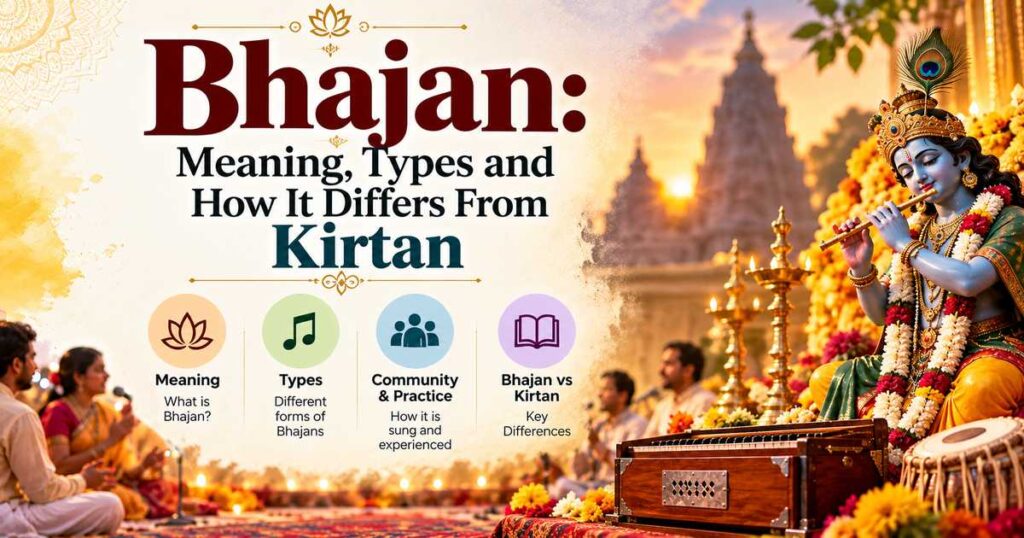
Somewhere in India tonight, a family is sitting on the floor after the evening lamp is lit. One person leads a song, and the others join in on the refrain. Elsewhere, a temple hall fills with the sound of a harmonium and hand cymbals, or a village stays awake through a festival night, singing. These are all, in different ways, bhajans.
If you have ever wondered about the bhajan meaning, the short answer is this: a bhajan is a devotional song, sung to express love for the divine, remember its qualities, or reflect on a spiritual teaching. But the word holds more than a dictionary line can carry, and it shifts with language, region and community. Bhajan is also often mentioned alongside kirtan, a related practice that overlaps with it but is not identical. This guide explains where the word comes from, the main kinds of bhajan, how they are performed, which instruments are used, and how a beginner can join in.
What Is the Meaning of Bhajan?
Bhajan is a devotional song traditionally sung to express devotion to a deity, remember divine qualities, or reflect on spiritual teachings. Bhajans are performed in homes, temples, satsangs and community gatherings, with styles varying across regions and traditions. The word comes from the Sanskrit root bhaj, linked with sharing, belonging and worship.
The word comes from the Sanskrit root bhaj. Reference works give the root a range of senses, including to share, to partake in, to belong to and, in devotional use, to revere or worship. Wikipedia’s entry on bhajan, which draws on standard encyclopaedias of Hinduism, notes this range, and mentions the well-known hymn title Bhaja Govindam, where the same root carries the sense of reverence. Bhakti, the word for loving devotion, comes from the same root, which is why bhajan and bhakti are so closely linked in everyday speech.
In older Sanskrit usage, bhajana can refer to worship or service in a general sense. In modern Hindi and many other Indian languages, it most often means the devotional song itself, and sometimes the gathering where such songs are sung. No single English word captures all of this. “Hymn”, “devotional song” and “sacred singing” each fit some situations and miss others.
Two things are worth knowing from the start. First, a bhajan has no one fixed form. It can be a simple line repeated by a family at home or a composition set to a classical raga. Second, the heart of a bhajan is usually its words: what is being said, to whom, and why.
What Is the Origin and Cultural Significance of Bhajans?
Devotional singing has deep roots in many Hindu traditions, and the shape bhajans take today owes a great deal to the Bhakti movements. Encyclopaedia Britannica describes Bhakti as a movement of intense, personal devotion that began in South India between the 7th and 10th centuries, in Tamil poems by the Alvars (devotees of Vishnu) and the Nayanars (devotees of Shiva). It later spread north, and its poets often wrote in everyday regional languages rather than Sanskrit, which let people sing and understand the verses outside the temple.
This is why the story of the bhajan is really many stories. The poets people usually name belong to different centuries, languages and devotional outlooks:
-
- Kabir (about 1440 to 1518, according to Britannica) composed in a Hindi idiom and is associated with devotion to a formless divine.
-
- Tulsidas (16th century) wrote the Hindi Ramcharitmanas, a retelling of the Rama story.
-
- Mirabai and Surdas are, along with Kabir, described by the scholar John Stratton Hawley as poet-saints of the fifteenth and sixteenth centuries. Their songs are widely associated with devotion to Krishna.
-
- Annamacharya is traditionally dated to the 15th century and is remembered as a Telugu composer devoted to Venkateswara at Tirumala.
-
- Tyagaraja (1767 to 1847) is a figure of a later age altogether. Britannica places him among the great composers of South Indian classical (Carnatic) music, with most of his songs in Telugu and most praising Rama.
These poets did not all belong to one movement, and their works do not fit one musical category. Tyagaraja’s kritis, for example, are classical compositions, while many songs of the North Indian poet-saints travelled through oral tradition. One more caution applies: many songs are attributed to Kabir, Mirabai and Surdas, but they were passed on orally for generations, and scholars treat the attribution of individual songs with care. When a bhajan carries a famous name, it is fair to say “attributed to”.
Beyond history, bhajans hold a practical place in community life. They are sung at festivals, on pilgrimages, in temples, at satsangs (gatherings for spiritual company and discussion), and in homes. Families often pass favourite songs down by ear. You can see devotional singing around many of the dates on our festival and events page.
What Are the Different Types of Bhajans?
There is no single, universally accepted classification. Bhajans can be grouped by deity, theme, language, region or musical style, and these groups overlap. The categories below are a practical guide, not a rulebook.
Devotional Praise Bhajans
Many bhajans simply praise: they list the names, qualities, stories or attributes of a deity. The hymn Bhaja Govindam, mentioned above, is a familiar title in this devotional spirit. Praise can be quiet and reflective or lively and joyful, and the same song may be sung both ways in different communities.
Krishna Bhajans
Songs to Krishna draw on themes of love, longing, surrender and the playful stories of his life. They are strongly associated with the Krishna-centred traditions of North India, including the poet Surdas, who is linked with the Ashtachhap group of poet-singers in the Vallabha tradition, and with Mirabai, whose devotion to Krishna is the heart of the songs attributed to her.
Rama Bhajans
Rama bhajans centre on the name of Rama, his qualities and the Ramayana tradition. Tulsidas’s Ramcharitmanas remains deeply influential across North India, and Tyagaraja’s Telugu compositions show how Rama devotion also shaped South Indian classical music. Rama songs are common at festivals such as Ram Navami and in evening gatherings.
Shiva Bhajans
Devotional songs to Shiva range from simple prayers to praise of his many forms and stories. In the South, the Tamil Nayanar poets, who sang to Shiva from around the 7th century, are among the oldest voices of Shaiva devotion. On nights like Maha Shivaratri, singing, chanting and keeping vigil are traditional ways to observe the day in many communities.
Devi Bhajans
Songs to the Divine Mother honour Durga, Lakshmi, Saraswati and many regional forms of the goddess. They are especially prominent during Navaratri, when nine nights of worship are marked with singing in homes and public gatherings. Local goddesses have their own songs, often in the local language.
Nirguna Bhajans
Some devotional poetry looks beyond a deity’s form and speaks of a divine that is formless or without attributes, known as nirguna. Kabir is the best-known poet of this stream, and the genre is often called Nirguni. The songs usually use plain, everyday images, such as weaving or travelling, to point to deeper ideas. This differs from saguna devotion, which centres on a deity with name and form, such as Krishna or Rama. The singer Pandit Kumar Gandharva is often credited with bringing wider attention to Kabir’s Nirguni songs.
Regional and Language-Based Bhajans
Devotional songs reflect the language and music of where they are sung. These labels describe traditions, not neat boxes:
-
- Hindi bhajans include the work of the North Indian poet-saints, and many songs in Hindi dialects.
-
- Telugu devotional songs include the compositions of Annamacharya and, in the Carnatic tradition, Tyagaraja.
-
- Tamil devotional compositions go back to the Alvar and Nayanar poets.
-
- Marathi abhangs are devotional verses closely associated with the Varkari tradition of Maharashtra and with saints such as Tukaram.
-
- Gujarati devotional songs include the widely sung bhajans of the saint-poet Narsinh Mehta.
-
- Kannada devotional compositions belong to the wider tradition of Bhakti poetry in the Dravidian languages that Britannica describes.
Related terms are not interchangeable. An abhang is a particular Marathi form. A keertana or kriti, in the South Indian classical tradition, is a composed song with its own structure and rules. A bhajan is the broader, looser word that can include many of these in everyday speech.
Traditional and Contemporary Bhajans
Bhajans can be sung unaccompanied, with a harmonium and drum in a living room, in classical-influenced styles, in folk traditions, or in modern recorded arrangements. Recordings and streaming have carried devotional music far beyond the places where it began, and have brought new instruments and studio production to it. None of this makes one style more spiritually genuine than another. Many people value the plain home version; others are moved by a polished concert. Both are part of the living tradition.
How Are Bhajans Traditionally Performed?
There is no single format, but several elements recur.
-
- A lead singer or small group begins a line or verse.
-
- Others join in, often on a repeated line or refrain.
-
- Lines are repeated, which helps newcomers learn quickly and keeps attention on the words.
-
- Instruments may accompany, though they are optional.
-
- The lyrics focus on devotion, praise, prayer or spiritual reflection.
-
- The setting varies, from one person singing alone to a temple hall or a night-long community gathering.
Some bhajans are sung by a solo singer, and others by a group. The structure depends on the composition and the local tradition. A song set to a raga may follow a fixed melodic pattern, while a simple home bhajan may be sung to a tune the family has used for generations.
Instruments Commonly Used in Bhajan Singing
Instruments support the singing; they are never essential. A bhajan can be sung without any accompaniment at all.
Harmonium
The harmonium gives a melody to follow and a steady pitch for the group. It is a relative newcomer: reed organs reached India in the mid-19th century, and Indian makers adapted them into the smaller, floor-played form now common. It became widely used in bhajan and kirtan, though some classical musicians have criticised it because its fixed notes cannot reproduce the gliding pitches of Indian classical music. All India Radio even banned it from broadcasts between 1940 and 1971, according to the same source.
Tabla and Dholak
These drums keep rhythm. The tabla is a pair of drums used widely in classical and devotional music, while the dholak is a two-headed hand drum often heard in homes, festivals and folk-influenced singing.
Manjira and Kartal
Manjira (small hand cymbals) and kartal (wooden or metal clappers) mark the beat. They are simple, portable and easy for a group to pick up, which is why they are so common in congregational singing.
Tanpura and Other Melodic Instruments
A tanpura provides a continuous drone, and some gatherings add a flute, violin, veena, or other melodic instrument. Which instruments appear depends on the tradition, the region and the occasion.
What Is the Difference Between Bhajan and Kirtan?
In brief: bhajan generally means a devotional song or devotional singing, while kirtan usually means group devotional singing or chanting, often in call and response, that praises divine names and qualities. The two overlap, and their meanings vary by tradition.
Britannica describes kirtana as musical worship in which a soloist sings a verse and a chorus repeats it, practised especially by the Vaishnava sects of Bengal and popularised by Chaitanya in the 15th and 16th centuries. The Hindu American Foundation describes kirtan in its best-known form as call-and-response singing of a mantra, often centred on Krishna, Radha, Rama or Sita. In Gaudiya Vaishnavism, singing the divine names together is a central practice.
Reference works frame the relationship in slightly different ways. Wikipedia describes bhajan as the looser form and kirtan as a more structured group performance, while the arts organisation Darbar places kirtan, as chanting of a name or mantra, at the simplest end of a wide range of bhajan. Both views are reasonable, and your own tradition may use the words differently still.
| Feature | Bhajan | Kirtan |
|---|---|---|
| General meaning | A devotional song or devotional singing | Devotional singing, chanting, or the practice of praising divine names and qualities |
| Common focus | Devotion, praise, prayer, stories or spiritual reflection | Often collective praise, chanting or repetition of divine names |
| Performance | Solo or group singing | Frequently participatory, sometimes with call and response |
| Musical structure | May follow a composed song structure or regional musical form | May involve repeated names, phrases, refrains or extended devotional sequences |
| Participation | May be individual or collective | Often encourages collective participation, depending on the tradition |
| Instruments | Varies by composition and region | Varies by tradition and performance style |
| Relationship | A broad form of devotional singing | A related practice that can overlap with bhajan singing |
This table shows common tendencies, not universal rules. Not every bhajan is slow, not every kirtan is fast, and not every kirtan uses call and response. A single evening of devotional singing may well include both.
What Is the Spiritual Significance of Bhajans?
For many devotees, bhajans do several things at once.
-
- They express devotion in a form that anyone can sing.
-
- They keep divine names and stories in memory, especially through repetition.
-
- They carry teachings, since many verses distil ideas from the saints in simple language.
-
- They bring people together, creating a shared devotional experience.
-
- They preserve poetry and regional music that might otherwise be lost.
Many people describe bhajan singing as calming or uplifting. That is a personal and traditional understanding, and experiences differ. It is not a medical claim: bhajans are not a treatment for any illness, and no devotional practice guarantees a particular spiritual result. The value lies in the practice itself, and in what it means to those who sing.
How Can Beginners Start Singing or Participating in Bhajans?
You do not need training to begin. Many gatherings welcome anyone who wants to listen or sing along.
-
- Choose a familiar devotional song, perhaps one from your family or one you have heard at a festival.
-
- Understand the meaning of the lyrics. Read a translation so you know what you are singing.
-
- Listen to a reliable recording or learn from an experienced singer in your family or community.
-
- Start with a simple melody and a comfortable rhythm. There is no need to attempt complex compositions at first.
-
- Practise one verse or refrain at a time. Repetition does much of the teaching.
-
- Join a family, temple or community gathering when you feel ready.
-
- Focus on understanding and participation, not perfect singing.
Formal musical training is not essential for many devotional gatherings, although some classical and composed forms do require advanced skill.
Frequently Asked Questions About Bhajan Meaning
What is the simple meaning of bhajan?
A bhajan is a devotional song. It is sung to express love and respect for the divine, to recall divine qualities or stories, or to reflect on a spiritual teaching. The word comes from the Sanskrit root bhaj, whose senses include sharing, belonging and worship, and today it usually means the song itself.
What does bhajan mean in Hinduism?
In Hinduism, bhajan is a form of devotional practice, usually singing, that expresses bhakti, or loving devotion. Its form and emphasis differ across traditions: some communities sing praise of a deity with name and form, others sing of a formless divine, and customs vary by region and family.
What is the difference between bhajan and kirtan?
Bhajan is generally a devotional song or devotional singing, while kirtan usually refers to group singing or chanting of divine names, often in call and response. The terms overlap, and different traditions and reference works use them slightly differently, so treat the difference as a tendency, not a fixed rule.
What are the main types of bhajans?
Bhajans can be grouped by deity (Krishna, Rama, Shiva, Devi), by theme (praise, devotion, teaching), by outlook (nirguna or saguna), by language and region, and by style (traditional or contemporary). These categories overlap, and no single classification is universally accepted.
Which instruments are used in bhajans?
Common instruments include the harmonium, tabla, dholak, manjira, kartal and tanpura. Which ones appear depends on the region, tradition and occasion. Instruments are optional, and many bhajans are sung with no accompaniment at all, relying only on voices and a steady clapped rhythm.
Can bhajans be sung at home?
Yes. Bhajans are commonly sung at home, alone or with family and friends, in the morning or evening or on festival days. Customs differ between families and communities, so follow whatever feels natural and respectful in your household. A small lamp, a quiet corner and a familiar song are often all that is needed.
Do you need musical training to sing bhajans?
No. Many bhajans are learned by listening and joining in, and gatherings usually welcome beginners. Some classical or composed devotional forms do involve advanced technique, but sincere participation matters more than polished singing in most settings, and a patient teacher or family elder can help you start.
What language are bhajans usually sung in?
There is no single language. Bhajans are composed and sung in Sanskrit, Hindi, Telugu, Tamil, Marathi, Gujarati, Kannada and many other languages, and in regional dialects. Which language you hear depends on the community, the saint-poet and the occasion, so no single language can be called the language of bhajan.
Conclusion
The bhajan meaning is simple to state and rich to explore. A bhajan is a devotional song, but it is also a way of remembering, a way of gathering, and a living inheritance from many poets, languages and regions. It differs from kirtan in tendency rather than in rigid rules, and the two often share a single evening.
Understanding a bhajan means more than recognising its tune. It means paying attention to its words, its devotional purpose, the tradition it comes from, and the community that sings it. Start with one song you know, find out what it says, and sing it in your own voice.
